
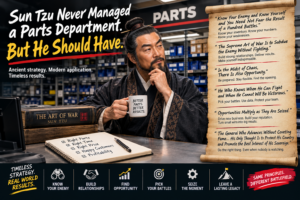
Sun Tzu wrote The Art of War roughly 2,500 years ago as a guide for military commanders navigating conflict, strategy, and the unpredictable nature of human behavior. He could not have imagined the automobile dealership. And yet, if you pick up his book today and read it through the lens of a dealership parts manager, the parallels are almost unsettling in how precisely they apply.
Consider this an unofficial field guide.
“Know Your Enemy and Know Yourself and You Need Not Fear the Result of a Hundred Battles.”
In parts department terms, your enemies are many and varied. Obsolescence is a slow-moving adversary that gains ground while you are distracted by other things. The service department is not exactly an enemy but is absolutely a rival power with competing interests and a loudly expressed opinion about your fill rate. Upper management reviews your numbers monthly and asks questions that suggest they may have confused your department with a vending machine. And the retail customer who arrives at 4:47 on a Friday afternoon needing a part you do not have — that individual is a force of nature unto themselves.
Know your inventory. Know your numbers. Know your weaknesses before someone else points them out in a meeting.
“The Supreme Art of War Is to Subdue the Enemy Without Fighting.”
Your service manager does not need to be your adversary. Neither does your Fixed Operations Manager. The parts manager who wins without conflict is the one whose fill rate is high enough that nobody has anything to complain about. When technicians get their parts quickly, when repair orders close on time, and when the month-end numbers look the way they should, the meeting about the parts department is a short one. The best parts managers are masters of this principle — they win by making themselves impossible to argue with.
Sun Tzu would have called this strategic. We call it having your act together.
“In the Midst of Chaos, There Is Also Opportunity.”
A backorder on a high-demand part is chaos. A DMS changeover is chaos. A buy-sell where the closing date moves three times in two weeks is chaos dressed in a suit. But chaos is also the moment that separates prepared parts managers from unprepared ones. The manager who has cultivated dealer relationships for emergency parts sourcing, who has a clean inventory that can be counted on short notice, and who has documented processes that hold up even when the team is short-staffed — that manager finds opportunity in the situations that paralyze everyone else.
Preparation is not exciting. Neither is winning, apparently. Sun Tzu was very calm about it.
“He Who Knows When He Can Fight and When He Cannot Will Be Victorious.”
Pick your battles with upper management carefully. The parts manager who argues every directive, pushes back on every initiative, and turns every performance review into a negotiation loses credibility quickly. But the parts manager who builds trust through consistent results, speaks up clearly when a decision will genuinely hurt the department, and backs their position with data rather than emotion — that manager wins the battles that actually matter.
This is also excellent advice for handling the customer who insists that the part they need is definitely in your bin because they looked it up on the internet last night. Choose your response carefully. The customer is not always right, but they are always the customer.
“Opportunities Multiply as They Are Seized.”
Every wholesale account you land opens the door to referrals. Every retail customer who leaves your counter satisfied becomes a potential service customer, a return buyer, and a word-of-mouth endorsement. Every inventory you run cleanly builds the reputation that brings the next client. In parts management as in ancient military strategy, momentum is real. Small wins compound. The department that is moving forward tends to keep moving forward, and the one that is standing still tends to stay there.
Seize the accounts. Seize the returns before the window closes. Seize the opportunity to submit that manufacturer return before it ages out. Sun Tzu would have been excellent at obsolescence management.
“The General Who Advances Without Coveting Fame and Retreats Without Fearing Disgrace — His Only Thought Is to Protect His Country and Promote the Best Interest of His Sovereign.”
Translation for the modern parts manager: do the right thing for the department even when nobody is watching, even when the credit goes to someone else, and even when the metric you improved does not show up on the report your dealer principal actually reads. A well-run parts department is largely invisible — and that invisibility is the highest possible compliment.
The bins are full. The count is accurate. The technicians have what they need. The service department is running smoothly. Nobody is calling a meeting about the parts department.
Sun Tzu would call that victory.
We just call it Tuesday.